Shoulder pain from sleeping follows a recognizable pattern: the discomfort is absent at bedtime, appears on waking, and improves within 30 to 60 minutes of movement — but returns the next morning after another night in the same position. Deltoid muscle pain when sleeping specifically involves the middle deltoid fibers and presents as lateral upper arm aching that is reproducible with resisted shoulder abduction in the morning. This differs from the deeper, clicking discomfort of rotator cuff involvement, which typically emerges as shoulder pain after sleeping on side when the full bodyweight compresses the supraspinatus tendon against the acromion throughout the night. Identifying which structure is producing the pain determines which position change and which exercises actually help.
Finding the best way to sleep with shoulder pain depends on whether the affected shoulder is the one being slept on or the opposite one. The mechanism differs entirely: the bottom shoulder bears compressive load, while the top shoulder hangs in internal rotation and drops forward when unsupported. Knowing how to relieve shoulder pain from sleeping wrong starts with understanding which of these loading patterns applies before choosing a mattress pad, pillow arrangement, or positional aid.
Position Mechanics and What Goes Wrong Overnight
The Compressed Shoulder vs. the Hanging Shoulder
Side-sleeping on the affected shoulder concentrates bodyweight through the greater tuberosity of the humerus into the mattress surface. In a healthy shoulder, the rotator cuff tendons handle this load without issue. After a prior injury, with existing tendinopathy, or in shoulders with reduced subacromial space due to bone spurs, this compression reproduces the same mechanical environment that causes impingement during the day. The result — pain that builds slowly over three to four hours of sustained side-sleeping — is not immediately felt and so is rarely associated with position by the sleeper until morning.
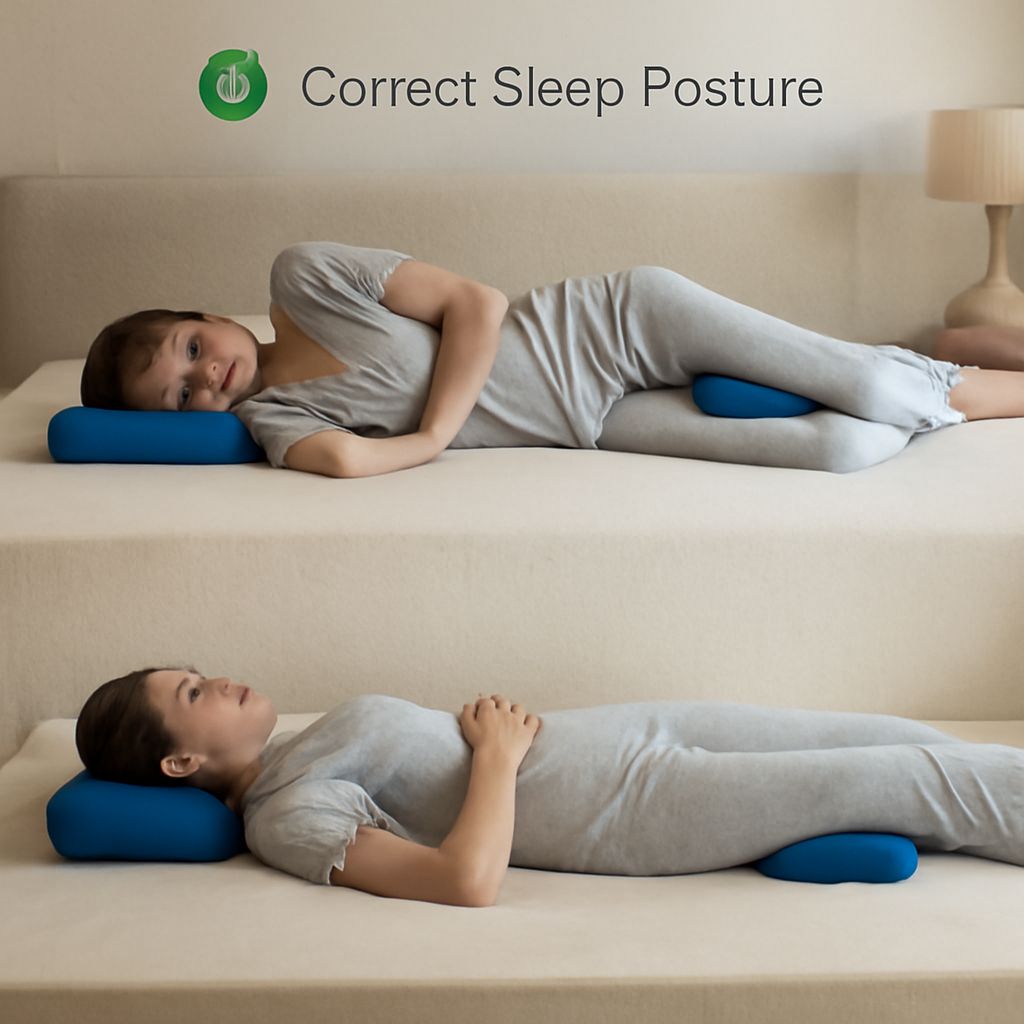
Side-sleeping on the unaffected side while the painful shoulder is on top creates a different problem. Without support, the top shoulder drops forward into protraction and internal rotation, stretching the posterior capsule and loading the biceps tendon at the supraglenoid attachment. A body pillow positioned in front of the torso, supporting the top arm from the elbow to the wrist, holds the shoulder in a neutral plane and removes that sustained stretch. The arm should rest at roughly heart level — too high tightens the thoracic outlet, too low allows the shoulder to droop forward again.
Back-sleeping distributes weight more evenly across the thorax and generally reduces shoulder loading to its lowest level of any sleeping position. The exception is back-sleepers who let the arms rest alongside the body with the shoulders internally rotated — prolonged internal rotation during sleep has been associated with anterior capsule tightening that presents as front-of-shoulder stiffness in the morning. A small pillow tucked under each elbow to slightly flex the arms and externally rotate the shoulders by 15 to 20 degrees corrects this within two to three nights.
Immediate Relief and Structural Prevention
For acute shoulder pain present on waking, a contrast protocol — two minutes of a cold pack over the lateral shoulder, followed by five minutes of a moist heat wrap — reduces inflammatory fluid faster than either modality alone. This takes about 20 minutes total and is most effective when performed while still in bed before rising, limiting the gravity-driven fluid pooling that worsens inflammation on standing.
Pendulum exercises — leaning forward with the arm hanging freely and drawing small circles with the hand for 60 seconds — decompress the glenohumeral joint by using the arm’s weight to distract the humeral head from the glenoid socket. This is the standard physical therapy opening exercise for shoulder pain because it produces measurable relief within 90 seconds and requires no equipment. Ten circles clockwise, ten counterclockwise, twice each morning, consistently outperforms stretching in patient-reported morning pain scores.
Mattress surface firmness affects shoulder loading. A softer surface allows more shoulder sinkage in side-sleepers, reducing the peak pressure under the greater tuberosity but increasing lateral trunk flexion. A mattress topper rated medium-soft (3 to 4 inch memory foam at 3.5 to 4 lb density) adds sinkage without replacing the underlying support structure, and can be tried before committing to a full mattress replacement.
Bottom line: Most shoulder pain from sleeping wrong traces to one of two patterns — compression of the bottom shoulder or unsupported hanging of the top one. Correcting position with a body pillow and adjusting mattress surface softness resolves most cases within two to four weeks. Pain that persists beyond four weeks of positional correction warrants orthopedic evaluation to rule out structural tendon damage.