Back Pain After Sleeping: Why It Happens and How to Fix It
Back pain after sleeping is not a random event — it follows predictable patterns tied to mattress support, sleep position, and spinal alignment over six to eight hours of relative immobility. Middle back pain after sleeping often points to thoracic spine loading from a mattress that is either too firm or too soft for the sleeper’s weight distribution, while mid back pain after sleeping in the thoracolumbar region frequently involves prolonged rotation at the T12–L1 junction during side-sleeping with poor hip and knee support. Both resolve faster when the underlying mechanical cause is identified rather than treated with pain relief alone.
Upper back pain from sleeping typically involves the rhomboids and mid-trapezius muscles — the shoulder blade stabilizers that hold sustained tension when a pillow pushes the head too far forward in back-sleepers, causing the thoracic spine to round. Upper back pain sleeping on the side with an arm tucked under the body compresses the supraspinatus and loads the anterior shoulder capsule, which refers pain into the mid-thoracic area on waking. In both cases, the pain is reproducible and position-specific, which makes it diagnosable without imaging.
Mattress, Position, and Structural Causes
How Mattress Firmness Affects Spinal Loading
A mattress that is too firm prevents adequate sinkage of the hips and shoulders in side-sleepers, leaving the lumbar spine suspended in lateral flexion for the entire sleep period. Research from the European Spine Journal found that medium-firm mattresses produced statistically lower back pain scores compared to firm mattresses in adults with chronic non-specific back pain — the medium-firm group reported 63 percent improvement versus 45 percent in the firm group after 90 days.
A mattress that is too soft allows the pelvis to sag below the shoulders, reversing lumbar lordosis and compressing the posterior intervertebral structures. The sag test — lying on the back and checking whether the lumbar spine touches the mattress surface without effort — gives a functional read on whether a mattress has adequate support. A properly supportive mattress allows a flat hand to slide under the lower back with slight resistance; no resistance indicates excessive sag.
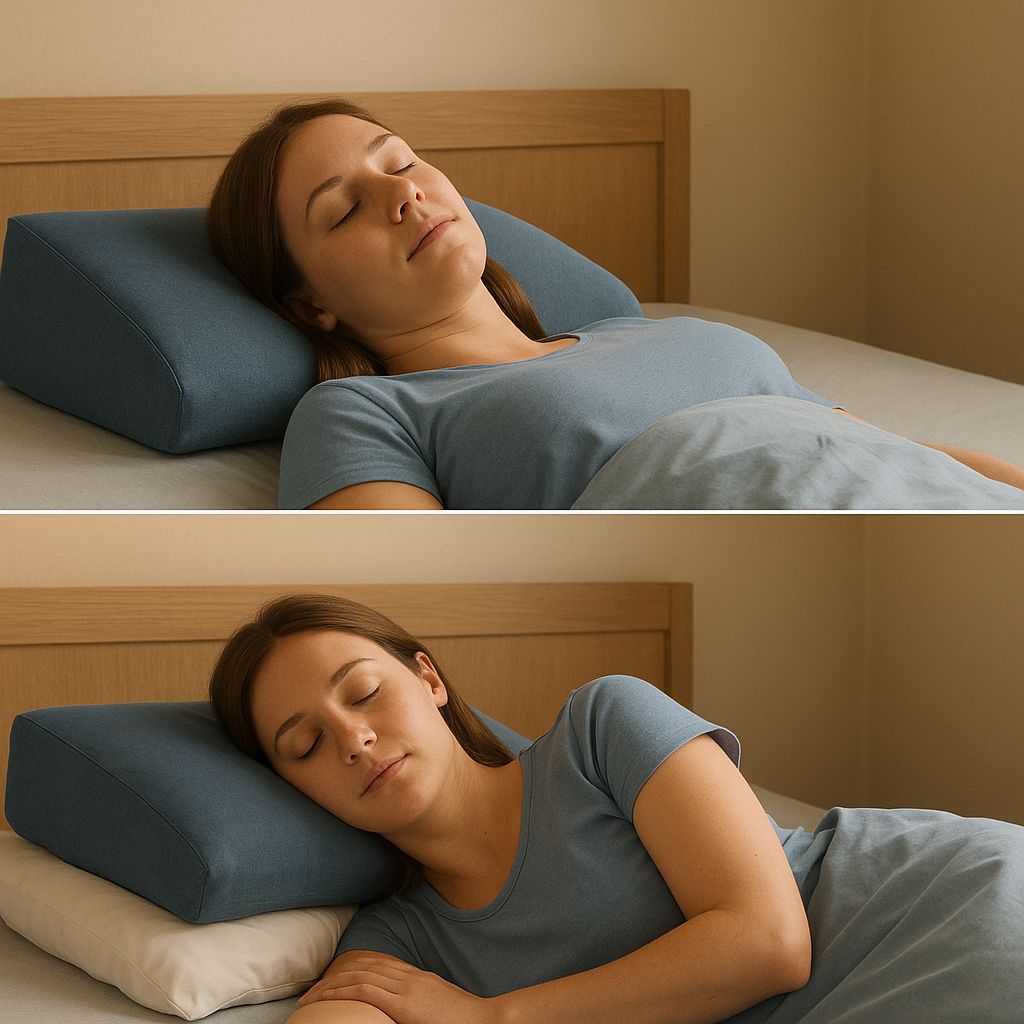
Sleep position interacts with mattress firmness in back pain development. Back-sleepers on a medium-firm mattress who place a pillow under the knees reduce lumbar spine compressive load by approximately 30 percent, as measured by intradiscal pressure studies. Side-sleepers benefit from a pillow between the knees, which prevents the top hip from internally rotating and pulling the lumbar spine into lateral flexion — the most common position associated with recurrent morning mid-back pain.
Active Recovery and Long-Term Prevention
Morning stiffness from back pain typically peaks within the first 15 to 30 minutes of rising as synovial fluid circulation resumes in the facet joints. A two-minute cat-cow sequence on hands and knees — 10 repetitions each direction — accelerates this process and reduces pain intensity before the first steps of the day. Each repetition should move through full available range slowly, pausing two seconds at each end position.
Chronic morning back pain that persists beyond 45 minutes regardless of position warrants medical evaluation, as it can indicate inflammatory arthritis rather than mechanical loading. Mechanical pain characteristically improves with movement and worsens after prolonged stillness; inflammatory pain follows a different pattern with morning stiffness lasting more than 60 minutes and improving with activity.
Long-term prevention centers on core endurance rather than core strength. McGill’s curl-up, the bird-dog, and the side bridge — performed daily in three sets of 10 repetitions — build the endurance capacity of the lumbar stabilizers that maintain spinal position during sleep. The sleeping spine is not truly still; postural muscle tone continues at a lower level throughout the night, and a stronger stabilization baseline reduces accumulated loading over eight hours.
Safety recap: Sharp unilateral back pain after sleeping that radiates into one leg, causes numbness or tingling in the foot, or is accompanied by bladder or bowel changes warrants prompt medical attention — these symptoms suggest nerve root involvement that requires evaluation rather than self-managed positional adjustment.