1 Hour of Sleep vs No Sleep: Sleep Study Results Explained
Getting 1 hour of sleep is not the same as getting no sleep, but the functional difference narrows significantly after the first night of deprivation. Sleep study test results show measurable differences between the two: one hour of total sleep preserves some slow-wave activity and allows adenosine partial clearance, while zero sleep produces continuous adenosine accumulation that impairs prefrontal cortex function within 17–19 waking hours. The debate of 3 hours of sleep vs no sleep is also studied directly; three hours preserves more declarative memory consolidation than none, though both leave reaction time and sustained attention severely impaired. Understanding the types of sleep studies helps clarify what these results actually measure—and whether the data applies to a single-night scenario or chronic partial sleep restriction.
What Sleep Studies Actually Measure
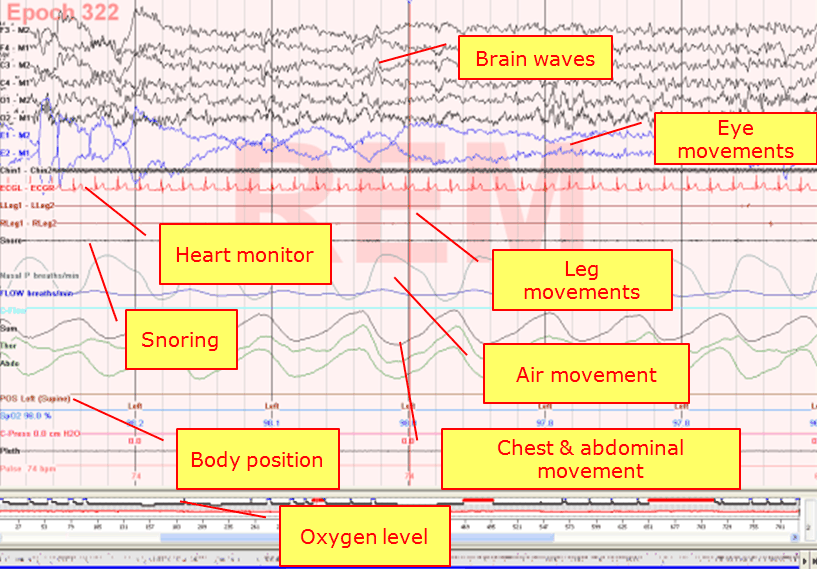
The four main types of sleep studies are: in-lab polysomnography (PSG), home sleep apnea testing (HSAT), multiple sleep latency testing (MSLT), and actigraphy. Each captures different data. PSG records EEG brain waves, eye movement, muscle tone, heart rate, respiration, and oxygen saturation simultaneously—producing the most complete picture of sleep architecture. HSAT records airflow, chest effort, pulse oximetry, and body position but not brainwave data, making it appropriate for apnea screening but not for staging sleep or measuring sleep duration accurately.
MSLT is the standard test for narcolepsy and idiopathic hypersomnia. It measures how quickly a person falls asleep in a quiet dark room during five 20-minute nap opportunities across the day. A mean sleep latency under 8 minutes indicates excessive daytime sleepiness; under 5 minutes with two or more sleep-onset REM periods meets diagnostic criteria for narcolepsy. This test requires the preceding night to include at least 6 hours of sleep, which means deliberately getting one hour of sleep before an MSLT would invalidate the results.
Sleep study test results for standard PSG report total sleep time, sleep efficiency (percentage of time in bed actually asleep), latency to sleep onset, latency to REM, and AHI. A normal AHI is under 5 events per hour; mild sleep apnea is 5–14, moderate is 15–29, and severe is 30 or more. These thresholds determine treatment recommendations.
The comparison of 3 hours of sleep vs no sleep in research settings consistently shows that even fragmented, short sleep outperforms total deprivation on cognitive tasks—but both groups perform significantly worse than a control group sleeping 7–9 hours. The practical takeaway: when facing a choice between one hour of sleep and none, the one hour is measurably better for next-day function, but neither is a safe substitute for adequate sleep before tasks requiring sustained attention, complex decision-making, or operating vehicles.