Sleeping Beauty Story: Origins, Versions, and What Changed
The sleeping beauty story traces back through centuries of oral tradition before its best-known written forms appeared in the 17th and 19th centuries. Most readers encounter the sanitized sleeping beauty fairy tale from Charles Perrault or the Brothers Grimm, but the sleeping beauty real story is considerably darker in its earliest sources. The story of sleeping beauty has been adapted, bowdlerized, and reframed so many times across European cultures that comparing versions reveals more about each era’s values than about the tale’s original meaning. The original sleeping beauty, as recorded by Giambattista Basile in 1634 in the Pentamerone collection, differs in plot structure, motivation, and outcome from anything produced by either Perrault or the Grimms — and understanding those differences clarifies what was preserved and what was changed in later retellings.
This guide examines the key variants in chronological order and identifies the specific plot points where they diverge.
Basile’s ‘Sun, Moon, and Talia’ (1634)
The Earliest Recorded Version
In Basile’s Pentamerone, a king’s daughter named Talia is cursed by a flax splinter and falls into a death-like sleep. Rather than being kissed awake, she remains unconscious as a passing king enters the tower and assaults her while she sleeps. She later gives birth to twins while still unconscious; one infant suckles her finger instead of her breast, accidentally drawing out the cursed splinter and waking her. The king eventually returns, acknowledges the twins, and plans to bring Talia to court. His existing queen discovers the situation and orders the twins cooked for dinner. The cook instead hides the children and serves substitute meat. The queen is burned to death, and the king marries Talia.
This original sleeping beauty omits any notion of true love, consent, or moral resolution. The sleeping beauty real story here is a tale about power, survival, and the precariousness of women’s safety — themes that later adaptations removed entirely.
Perrault’s Version (1697) and the Grimm Adaptation (1812)
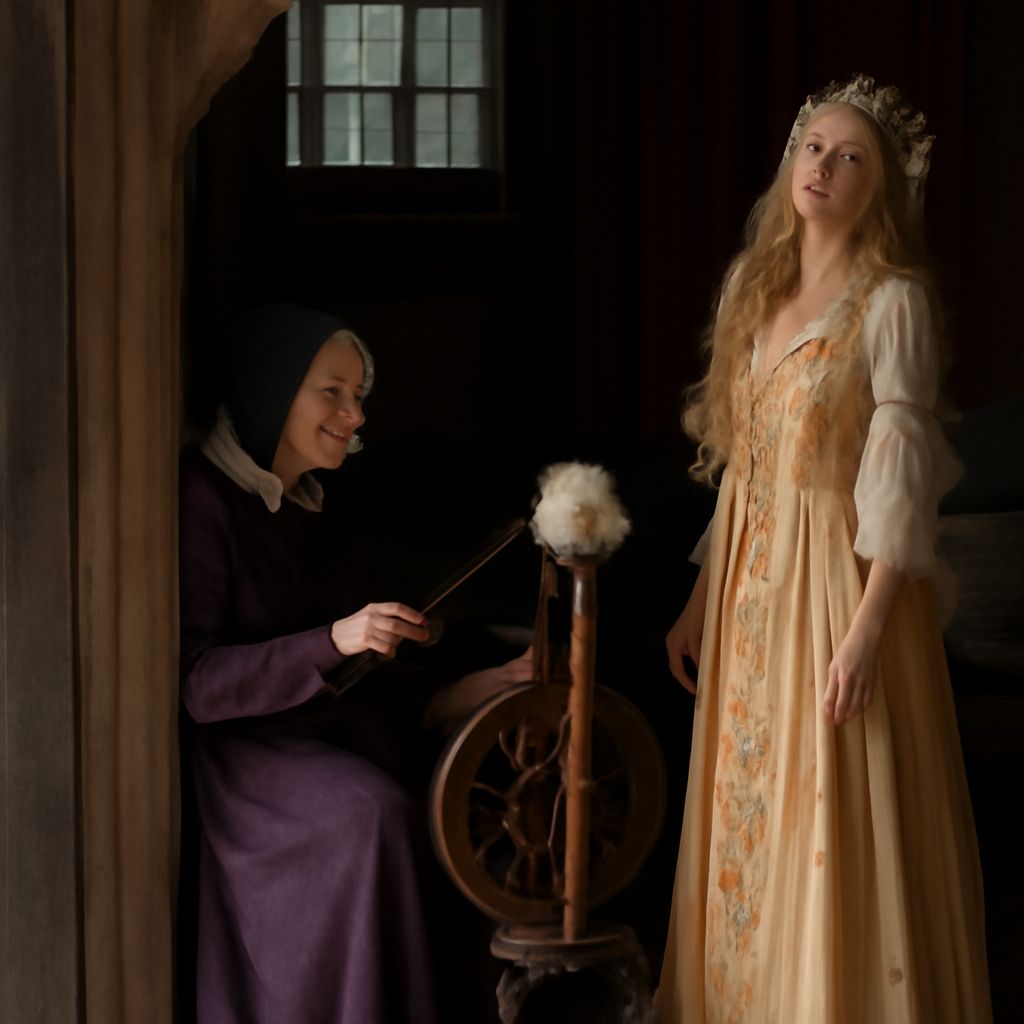
Charles Perrault’s “La Belle au bois dormant” introduced the spinning wheel, the 100-year sleep, and the prince’s kiss as the waking mechanism. The sleeping beauty fairy tale in this form is a two-part story: the first part ends with the couple’s marriage, and the second part (largely omitted in modern retellings) returns to the cannibalistic queen-mother-in-law, echoing Basile’s murderous queen plot.
The Brothers Grimm version, “Dornroschen” (Little Briar Rose), removes the second part entirely and ends with the kiss and awakening. This version is the one most frequently retold in children’s books and animated adaptations. The Grimm text changed the castle to a briar-covered fortress, added the detail that the entire court falls asleep with the princess, and reframed the wise women (fairies in Perrault) as the source of both the curse and its partial mitigation.
Disney and Modern Retellings
Disney’s 1959 film drew primarily from Perrault, adding Tchaikovsky’s ballet score elements and visual imagery. The villain Maleficent was expanded from a minor scorned fairy into a primary antagonist, a character note absent from all written predecessors. The 2014 Maleficent film reversed the story entirely, reframing the prince’s kiss as insufficient and replacing it with maternal love.
More recent theatrical productions and literary adaptations have returned to examining the story of sleeping beauty through the lens of the Basile source, using the uncomfortable original plot as a starting point for commentary on agency and power. These versions restore what the Grimm and Disney iterations deliberately obscured, treating the original as relevant social text rather than problem material to be edited out.
The arc from Basile to Disney shows a consistent pattern: successive adaptations shortened the narrative, softened or removed violence and assault, added romantic motivation, and relocated moral authority from survival to love. Understanding this pattern makes it easier to read any new sleeping beauty adaptation and identify which tradition it draws from and which elements it chooses to preserve or discard.