Why Do I Drool in My Sleep? Understanding Sleep Drool
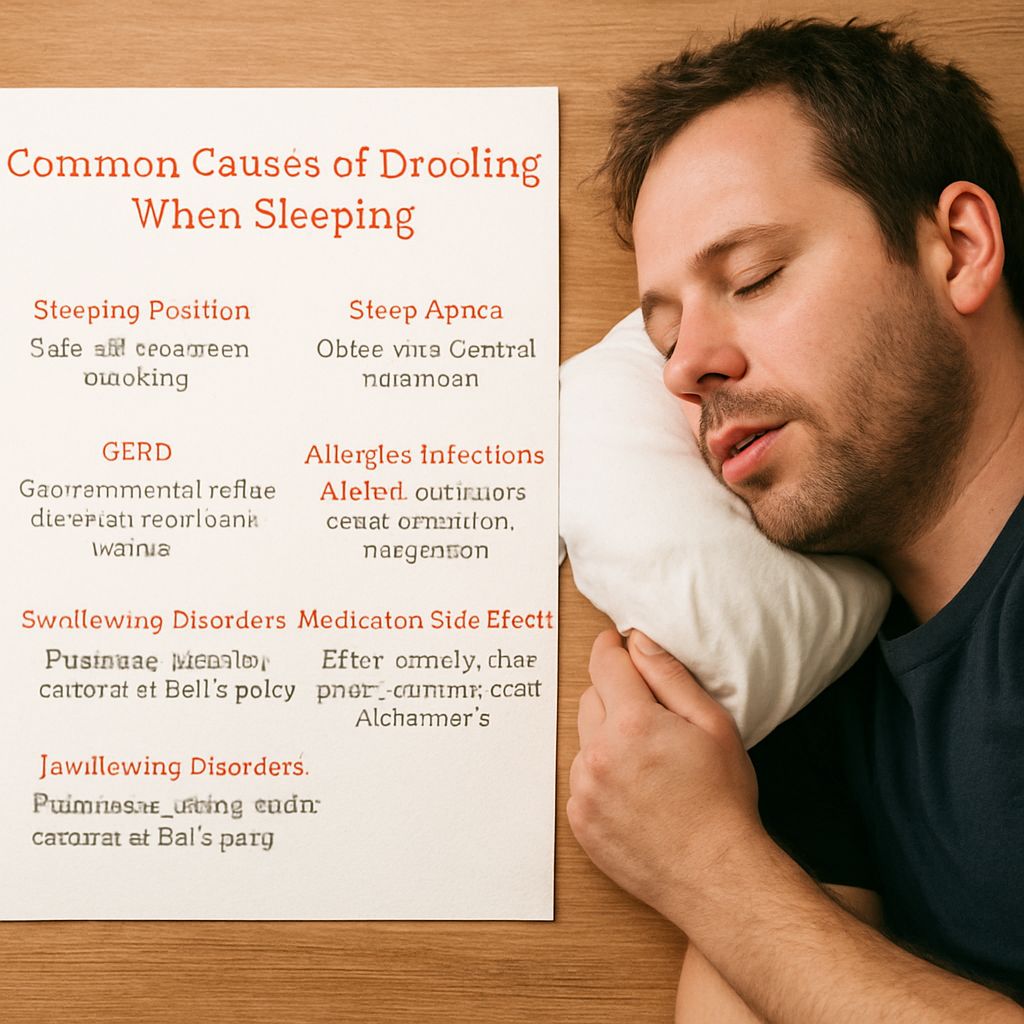
Why do i drool in my sleep is a question most people ask after waking up to a wet pillow — a common enough experience that it has dedicated product categories of absorbent pillowcases and specialized pillows. Drooling in your sleep becomes persistent when structural, behavioral, or physiological factors prevent normal saliva clearance during the night. Drooling sleep patterns correlate most strongly with sleeping position: side and stomach sleepers drool at significantly higher rates than back sleepers because gravity pulls accumulated saliva toward an open corner of the mouth. Sleep drool volume increases during the night for most people because swallowing frequency drops from hundreds of times per day while awake to as few as 3 to 10 times per hour during deep sleep, allowing saliva to pool. Drooling in my sleep specifically may signal nasal obstruction, medication effects, or early signs of neurological changes when it is new-onset in adults who previously did not experience it.
This guide explains the physiology, the most common structural and behavioral causes, and when evaluation by a clinician is warranted.
Physiological Basis of Sleep Drool
Saliva Production and Swallowing During Sleep
The salivary glands — parotid, submandibular, and sublingual — produce 0.5 to 1.5 liters of saliva per day, with production rate varying by circadian rhythm and food stimulation. During sleep, total salivary output drops by roughly 30 to 50 percent compared to waking hours, but this reduction is smaller than the concurrent drop in swallowing frequency. Waking swallowing clears the oral cavity hundreds of times daily; sleep swallowing happens 3 to 10 times per hour. The gap between production rate and clearance rate is what produces drooling in your sleep when gravity assists exit.
REM sleep atonia reduces muscle tone across the body, including the orbicularis oris that seals the lips. This is why sleep drool is heaviest during early morning hours when REM stages are longest and most intense. People who report waking with minimal drool on weeknights but more on weekends — when sleep is longer — are likely experiencing increased REM time from sleep extension as the primary driver.
Structural and Behavioral Causes
Nasal congestion from allergies, a deviated septum, or upper respiratory infection forces mouth breathing. Open-mouth breathing eliminates the tongue-palate contact that normally retains saliva in the posterior oral cavity, allowing it to flow forward toward the lip commissures. Treating the underlying nasal obstruction — nasal steroid spray for allergic rhinitis (effective in 2 to 4 weeks of daily use), saline rinse before bed, or surgical evaluation for structural obstruction — resolves most nasal-driven cases of drooling in my sleep.
Certain medications cause hypersalivation (increased saliva production) as a direct side effect. Clozapine, used in treatment-resistant schizophrenia, causes drooling in sleep in up to 80 percent of users by blocking the M4 muscarinic receptor that normally inhibits nocturnal salivation. Pilocarpine and other cholinergic agents prescribed for dry mouth conditions can produce similar effects. Any new-onset drooling in your sleep coinciding with a medication change warrants discussion with the prescriber.
When to Consult a Clinician
New-onset drooling in sleep that appears suddenly in a previously unaffected adult, particularly when accompanied by facial weakness, difficulty swallowing, changes in speech clarity, or limb weakness, requires prompt evaluation for neurological causes. Bell’s palsy reduces orbicularis oris tone unilaterally and can cause asymmetric sleep drool as an early symptom. Central nervous system events affect swallowing reflex timing.
Persistent drooling sleep patterns that do not respond to positional changes (switching to back sleeping) and nasal treatment over 4 to 6 weeks in otherwise healthy adults should prompt assessment for obstructive sleep apnea, which generates repeated arousal-triggered breathing attempts that increase open-mouth air hunger and associated salivary loss.